War is Peace
War is Peace is one of the three slogans of the Party in Oceania, displayed with Freedom is Slavery and Ignorance is Strength on the white pyramidal face of the Ministry of Truth and repeated whenever the Party asserts its creed. It is at once the most paradoxical and the most programmatic of the three, because it converts an apparent contradiction into a political machine: war is declared to be the condition that makes peace possible. In the novel the slogan forms the link between public propaganda and private confession, since it is the title of Chapter III of Emmanuel Goldstein's forbidden book The Theory and Practice of Oligarchical Collectivism, where its inner meaning is analysed, and it is the doctrine Winston Smith finally accepts when he learns to love Big Brother.
The Slogan as Public Creed
The three slogans appear in elegant lettering on the white face of the Ministry of Truth, a three-hundred-metre pyramid of glittering white concrete with three thousand rooms above ground level, and they return in the same words at the climax of the Two Minutes Hate after the face of Big Brother fades from the screen. They are also stamped on the twenty-five-cent piece in Winston's pocket, with Big Brother's head on the other face, so that even a coin carries the Party's eyes and slogans into every ordinary transaction. Winston meets them again on the telescreen at moments of despair, and they come back to him like an answer to the question whether the Party's dominion can endure forever. The Ministry of Peace, which concerns itself with war, is one of the four Ministries whose names reverse their functions, and the economy drive in preparation for Hate Week keeps the lift at Victory Mansions out of action and the electric current switched off during daylight. In Winston's mind the slogans belong with Newspeak, doublethink and the mutability of the past as the sacred principles of Ingsoc.
The Expository Meaning in Goldstein's Book
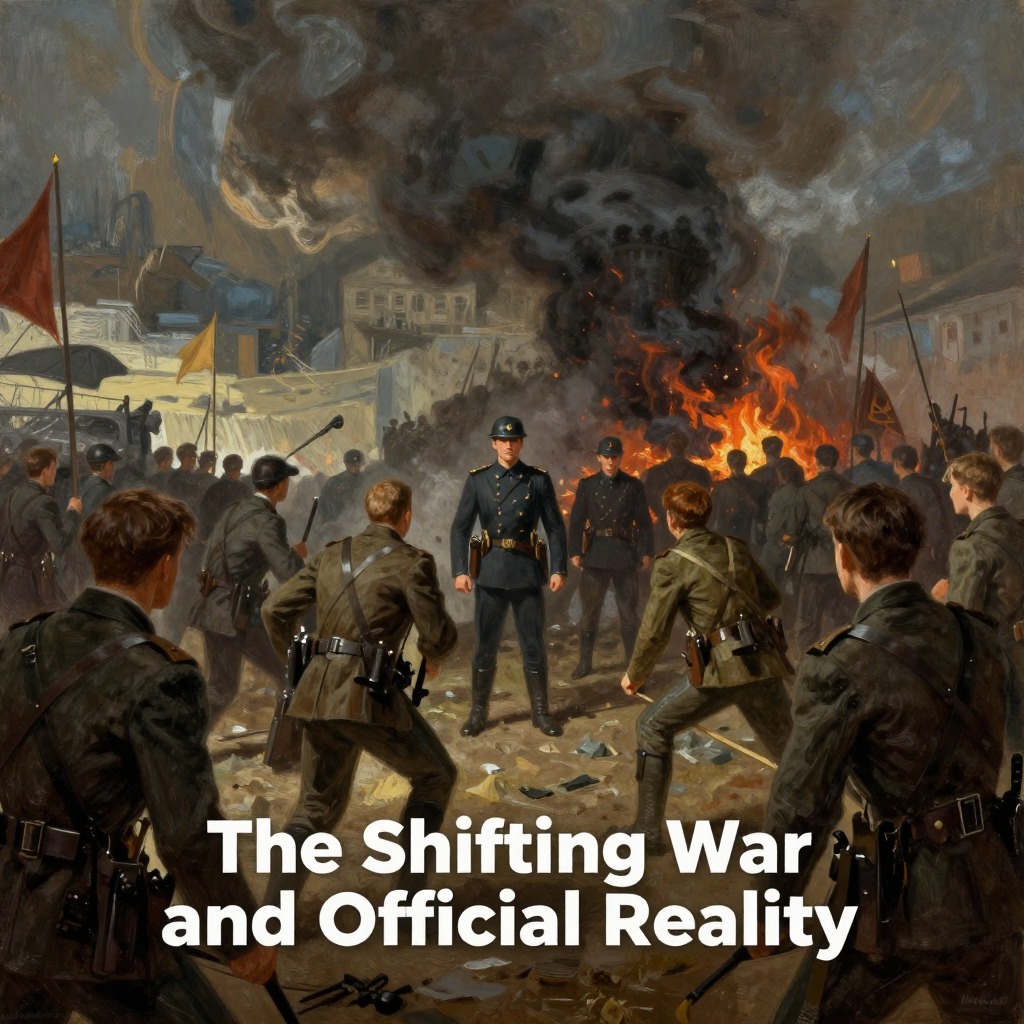
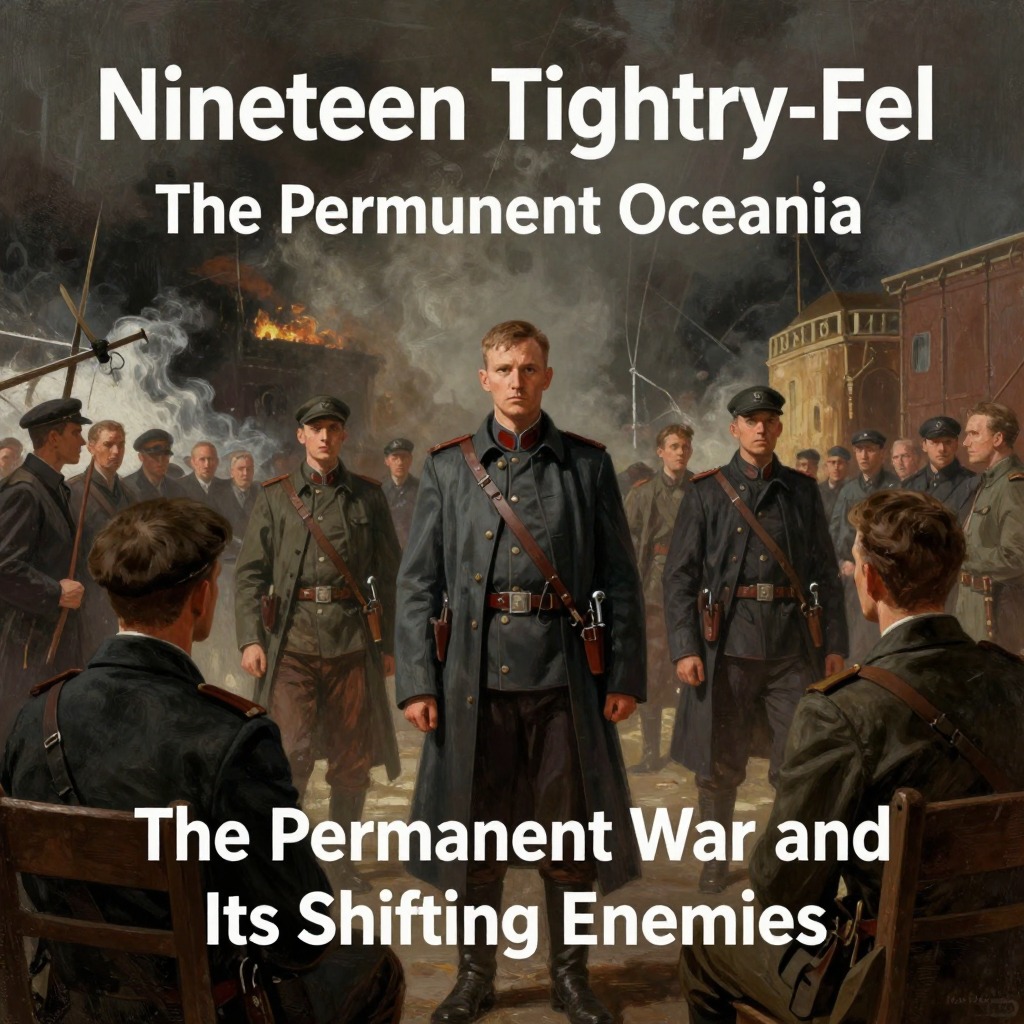
Chapter III of The Theory and Practice of Oligarchical Collectivism, titled War is Peace, gives the slogan its fullest exposition. The book explains that the world is split into three superstates, Oceania, Eurasia and Eastasia, which are permanently at war, though the war is a warfare of limited aims between combatants unable to destroy one another and not divided by any genuine ideological difference. Its function is to use up the surplus products of the machine without raising the general standard of living, so that a hierarchical society can survive; a Floating Fortress, for example, locks up in itself the labour that would build several hundred cargo ships and is finally scrapped without ever having brought material benefit to anybody. Because continuous war can never be decisive, it ceases to be dangerous, and the rulers of each superstate are free to twist reality into whatever shape they choose. The book concludes that a peace that was truly permanent would be the same as a permanent war, which is the inner meaning of the slogan.
Propaganda, Doublethink and the Everyday Operation
At the level of daily life the slogan is kept alive by devices such as the Two Minutes Hate, in which Emmanuel Goldstein is exhibited as the Enemy of the People, the primal traitor whose doctrines are blamed for every heresy. Rumours describe a vast shadowy army, the Brotherhood, and a terrible book without a title, of which Goldstein is the author, circulated clandestinely; neither is a subject that any ordinary Party member would mention if he could avoid it. The rituals of Hate Week add banners, processions and manufactured enthusiasm, while the Ministry of Plenty announces that the standard of living has risen by twenty per cent and that workers have marched out of factories to thank Big Brother, even as the chocolate ration is reduced from thirty grammes to twenty and then celebrated as raised to twenty grammes. Winston reflects that Parsons swallows the contradiction with the stupidity of an animal, the fanatical man at the next table swallows it with rage, and even Syme swallows it through doublethink, leaving Winston alone in the possession of a memory. The same operation is performed by the Ministry of Truth, which rewrites the past so that every prediction of the Party can be shown to have been correct; from the totalitarian point of view memory is relatively easy to deal with because there is always an agency to deny the memories of others. Orwell traced this mental discipline to what he called the schizophrenic manner of thinking of the English Left, in which words like democracy could bear two irreconcilable meanings.
Power as the Hidden Referent
Inside the Ministry of Love, where there are no windows and the streets leading to it are guarded by gorilla-faced men with jointed truncheons, O'Brien gives the slogan its definitive gloss. The Party, he tells Winston, seeks power entirely for its own sake; it is interested solely in power, not in wealth, luxury, long life or happiness, and no one seizes power with the intention of relinquishing it. Power is power over human beings, exercised by making them suffer, because obedience is not enough unless the person obeying is suffering. The world the Party is creating is the exact opposite of the hedonistic utopias imagined by old reformers, a world of fear, treachery and torment in which progress means progress towards more pain and a boot stamps on a human face forever. The slogan is completed by the economic analysis in Goldstein's book: scarcity increases the importance of small privileges, magnifies the distinction between one group and another, and makes the handing over of all power to a small caste seem the natural, unavoidable condition of survival.
Narrative Arc and Final Irony
Apart from its place on hoardings and coins, the slogan reaches into Winston's private writing. He opens the diary knowing that the act is not illegal, since there are no longer any laws, but that detection would mean death or at least twenty-five years in a forced-labour camp; he writes that thoughtcrime is death, and later asserts that freedom is the freedom to say that two plus two make four. After his arrest he is made to write TWO AND TWO MAKE FIVE on a slate, and in the Chestnut Tree Café he traces 2 + 2 = 5 in the dust on the table. The final scene completes the arc: watching Big Brother's portrait and listening to the announcement of a great victory, Winston feels that White always mates, that everything is all right, that he has won the victory over himself, and that he loves Big Brother. It has taken him forty years to learn what kind of smile is hidden beneath the dark moustache. Orwell's own politics, as the novel's introduction insists, were to the left of the official Left, and the book was not written as a simple anti-communist tract, but in the ending the slogan's logic has swallowed the man who once believed the truth was on his side.